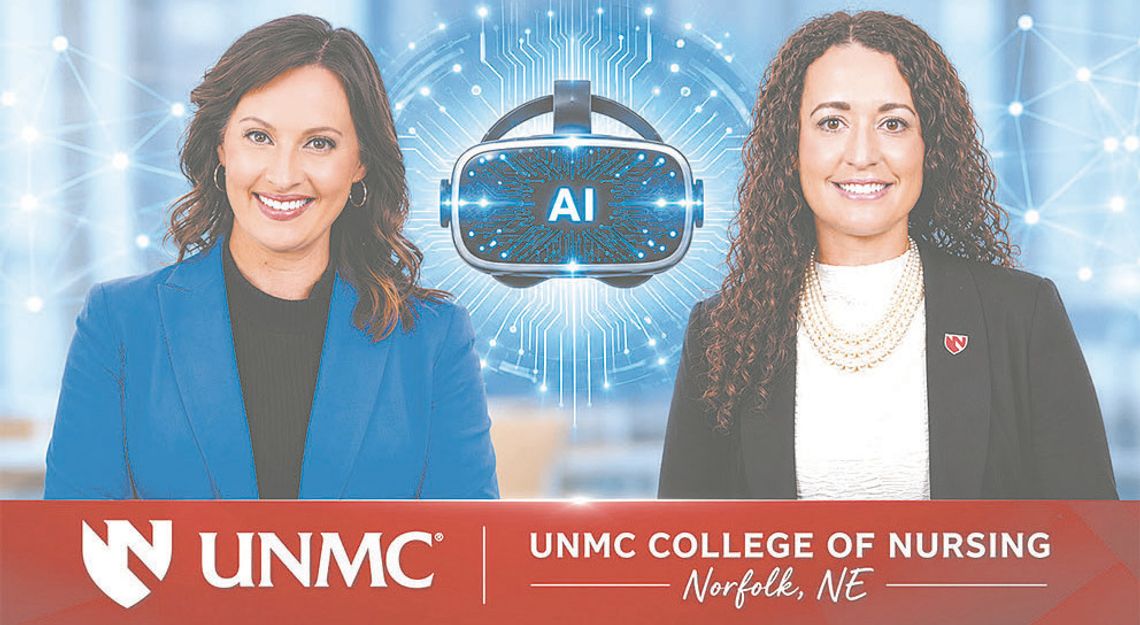
Over the past year, Dr. Jenna Hesse, of Humphrey, and Dr. Angela Johnson, assistant professors at the University of Nebraska Medical Center College of Nursing Northern Division, as well as a few other researchers, have been studying the impact of artificial-intelligence-generated immersive virtual reality simulation on nursing students.
Their research originated from a commitment to advancing evidence-based innovation in nursing education. They wondered if there could be actual quantifiable data proving that AI-generated simulation education helps nursing students learn more efficiently and effectively.
There were 42 nursing students involved, the entire junior class at UNMC in Norfolk. Those students were evaluated at three checkpoints: Physical simulation performance (checkpoint 1), which became their baseline; the first AI-generated IVR simulation attempt (checkpoint 2); and the second AI-generated IVR simulation attempt (checkpoint 3) using the Creighton Competency Evaluation Instrument (C-CEI) and AI-generated data analytics. After that, the study assessed the students’ satisfaction with the simulation using the Simulation Effectiveness Tool-Modified (SET-M).